Showing posts with label Satyriinae. Show all posts

Monday, 20 March 2017

260. Mycalesis cf. adamsonii (The Watson's Bushbrown)

Number: 260
Family: Nymphaliidae
Sub-Family: Satyriinae
Species: Mycalesis cf. adamsonii Watson, 1897
Common name(s): The Watson's Bushbrown
Photography location: Ba Vi N.P. (Hanoi)

Mycalesis inopia is one of the 3 vietnamese Mycalesis (with adamsonii and inopia) in which Up of both wings don't exhibit ocelli.

Underwings of Mycalesis inopia appears to be very similar to that of M. adamsonii. Both show a broad white postdiscal band suffused with violet on both wings bearing the same arrangement of ocelli. But according to me (to be confirmed), area from base to postdical band is blackish in inopia wheras it appears somewhat brown ochraceous in adamsonii.

Identification is easy with voucher specimens: M. inopia show black Up (brown in adamsonii) and the male lacks a brand on the UpF (brand overlaid by a hair tuft in space 1b in adamsonii).

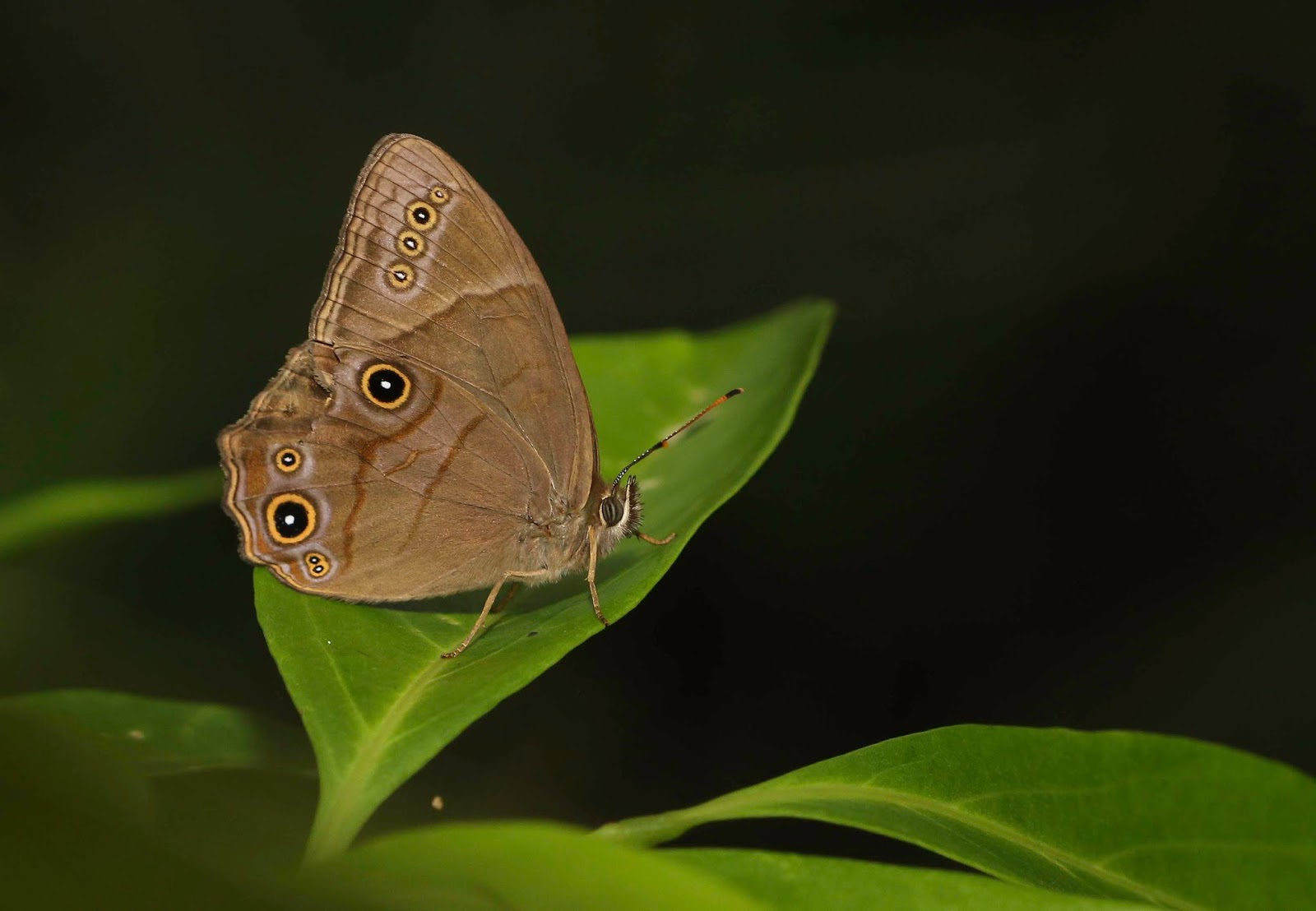
Mycalesis cf. adamsonii, Ba Vi (May 2016) - without flash

Mycalesis cf. adamsonii, Ba Vi (June 2016) - with flash

Saturday, 18 March 2017

256. Mycalesis mucianus mucianus (The South China Bushbrown)

Number: 256
Family: Nymphaliidae
Sub-Family: Satyriinae
Species: Mycalesis mucianus mucianus Fruhstorfer, 1908
Common name(s): The South China Bushbrown
Photography location: Ba Vi (Hanoi), Tam Dao (Vinh Phuc Prov.)

Recently this species was known as M. zonata Matsumuza, 1909.
The nominate subsp. occurs in S.E. China, N. & C. Vietnam (to Gia Lai Prov.); the subsp. zonata, in Taiwan.

 Mycalesis mucianus, Tam Dao foothills (November 2016)
Note FW with apex truncated

Another specimen, from Ba Vi foothills (April 2017)


255. Heteropsis malsara (The White-line Bushbrown)

Number: 255
Family: Nymphaliidae
Sub-Family: Satyriinae
Species: Heteropsis malsara (Moore, 1858)
Common name(s): The White-line Bushbrown
Photography location: Ba Vi foothills (Hanoi)

This species was earlier considered to be part of the genus Mycalesis but phylogenetic studies have re-classified them in genus Heteropsis (Kodandaramaiah et al., 2010).

Heteropsis malsara occurs in N. India, Burma, Thailand, Laos, N. & C. Vietnam.

Heteropsis malsara (December 2016, Ba Vi foothills, secondary vegetation) 
Note underwings basal and discal areas more or less finely striated, the wide postdical band on both wings

Same individual, upperwings
Note the prominent whitish discal band on UpF

Another specimen - wet season form

Dry season form (March 2018, Ba Vi foothills)

Voucher specimen from Ba Vi, underside (April 2017)

Same specimen, upperside

Saturday, 21 January 2017

239. Ypthima imitans (The False Four-ring)

Number: 239
Family: Nymphaliidae
Sub-Family: Satyriinae
Species: Ypthima imitans Elwes & Edwards,1893
Common name(s): The False Four-ring
Photography location: Tam Dao (Vinh Phuc Prov.)

The genus Ypthima comprising more than 100 species, of which 25 are known to occur in Vietnam.
Ypthima imitans is a restricted range species recorded in Vietnam (N. & C.), S.-E. China, Hainan.

Ypthima imitans, Tam Dao (900m asl, June 2016)
At Tam Dao, found both in lowland (<400) and low montane (400-1,300m) forests, even in degraded ones

Another specimen, from Tam Dao also (July 2016)

Voucher specimen showing both upper and underwing surfaces 

References; Uémura Y. & Monastyrskii, A.L., 2004. A Revisional Catalogue of the genus Ypthima Hubner (Lepidoptera : Satyridae) from Vietnam. You can download it here.

Friday, 23 December 2016

227. Lethe naga (The Naga Treebrown)

Number: 227
Family: Nymphaliidae
Sub-Family: Satyriinae
Species: Lethe naga Doherty, 1889
Common name(s): The Naga Treebrown
Photography location: Tam Dao (Vinh Phuc Prov.)


Lethe naga (male)Tam Dao foothills (100m asl), 15th June 2016

Lethe naga (male), Tam Dao (900m asl), 23th June 2016
Note the rather plain underwing pattern with a row of postdiscal ocelli in line in spaces 2-6 of FW
Female is larger and with a broad oblique underwing white band on FW

Wednesday, 14 December 2016

221. Lethe philesanoides (The Interrupted Treebrown)

Number: 221
Family: Nymphaliidae
Sub-Family: Satyriinae
Species: Lethe philesanoides Monastyrskii & Devyatkin, 2003*
Common name(s): The Interrupted Treebrown
Photography location: Huu Lien N.R. (Lang Son Prov.) 

Described from northern Vietnam (holotype: Cat Ba National Park/paratypes: Huu Lien Nature Reserve), This inhabitant of limestone forests is also known from northern Thailand. 
Lethe philesanoides is very similar to L. philesana Monastyrskii & Devyatkin, 2000. The two species can be distinguished by some details on the underwings pattern (see PDF documents below)*.

*Update January 2017: I sent the pictures below to A. Monastyrskii who answered: "Your specimen looks like L. philesana... however only genitalia analysis may confirms this".

Lethe philesanoides (male), Huu Lien (October 2016) - without flash (close to the "true colour" of the species)

Lethe philesanoides (female), Huu Lien (October 2016) - with flash

There are over 1100 butterfly species currently known from Vietnam. Approximately 7% of all species are considered as endemic to the Indochinese Peninsula (Vietnam, Laos, Cambodia and eastern Thailand) (Monastyrskii, 2010a). This is the case of Lethe philesanoides.


Voucher specimen, upperside (from Huu Lien)
Ground colour of both wings uniform deep velvet brown-black; apex indistinctly paler. 

Same individual, underside

Description of Lethe philesanoides (PDF document) here.
Description of L. philesana here.

Wednesday, 7 December 2016

214. Neorina patria westwoodii (The White Owl)

Number: 214
Family: Nymphaliidae
Sub-Family: Satyriinae
Species: Neorina patria westwoodii Moore, [1891]
Common name(s): The White Owl
Photography location: Tam Dao (Vinh Phuc Prov.)

Neorina patria is a large species of satyrine butterfly found in India (Assam), Burma, Thailand, Laos, China and Vietnam. 
In Vietnam, this montane species is recorded from the north and center of the country (to Ha Tinh Prov.) (Monastyrskii  & Devyatkin, 2016).

Neorina patria westwoodii - Tam Dao, 16th November 2016
Specimen found in relatively undisturbed closed forest, at 900m asl


Tuesday, 6 December 2016

213. Lethe verma stenopa (The Straight-banded Treebrown)

Number: 213
Family: Nymphaliidae
Sub-Family: Satyriinae
Species: Lethe verma stenopa Fruhstorfer, 1908
Common name(s): The Straight-banded Treebrown
Photography location: Tam Dao (Vinh Phuc Prov.)

This is my 8th Lethe species seen in Vietnam... but 39 are listed in "Butterflies of Vietnam, an illustrated checklist" (Monastyrskii  & Devyatkin, 2016)... arghhh !!!

Lethe verma stenopa, Tam Dao, 25th August 2016
L. confusa and L. verma are very similar but the latter show HW weakly toothed at vein 4 (making the HW appear more rounded), HW subbasal whitish line zigzag, not as straight as that of confusa

212. Lethe mekara crijnana (The Common Red Forester)

Number: 212
Family: Nymphaliidae
Sub-Family: Satyriinae
Species: Lethe mekara crijnana Fruhstorfer, 1911
Common name(s): The Common Red Forester
Photography locations: Tam Dao (Vinh Phuc Prov.), Ba Vi (Hanoi) foothills


I only managed some poor record shots (heavily cropped) for now... until the next time we meet!

Female (left) from Tam Dao, Sept. 2016 / Male (right) from Ba Vi, Dec. 2016
                                    In male, FW without subapical white bar beyond the cell

Lethe mekara, female, upperside (voucher specimen from Ba Vi, April 2017)

Monday, 5 December 2016

211. Lethe europa niladana (The Bamboo Treebrown)

Number: 211
Family: Nymphaliidae
Sub-Family: Satyriinae
Species: Lethe europa niladana Fruhstorfer, 1911
Common name(s): The Bamboo Treebrown
Photography location: Ba Vi N.P. (Hanoi)

Well, after a number of years of searching but having little knowledge of the species, I finally clapped eyes on it: Lethe europa. I only managed a record shot (heavily cropped) as it was just too far out of reach. Still, I know where it is now and will search for it again next year (it is right at the end of its flight season now). It was worth all the effort - it really is a beautiful thing. For a naturalist, the most wonderful feeling is spotting a new species for the first time. I want to do cartwheels and backflips when I see something new. 

Northern Vietnam is a site of particularly high level of diversity for this genus, hosting over 80% of the known number of species (Monastyskii pp.32. in Anon, 2001).

In Greek mythology, Lethe, the river of forgetfulness, was one of the five rivers of the underworld, the other four being Styx (the river of hate), Acheron (the river of sorrow), Cocytus (the river of lamentation) and Phlegethon (the river of fire).

Male Lethe europa niladana, lower slopes of Mount Ba Vi, 4th December 2016
Female is similar but with broader oblique white band on FW

Wednesday, 29 June 2016

180. Mycalesis deficiens

Number: 180
Family: Nymphaliidae
Sub-Family: Satyriinae
Species: Mycalesis deficiens Fruhstorfer, 1906
Common name(s): ?
Photography location: Tam Dao foothills (Vinh Phuc Prov.)

Endemic of Laos, Vietnam (N. & C.) and N. Thailand. Type locality is "Chiem Hoa", Tonkin. 
This is apparently the very first image of this species in the wild posted to the internet.

ID credit: Alexander Monastyrskii

Voucher specimen from Tam Dao, upperside

Sunday, 22 May 2016

173. Lethe syrcis diunaga

Number: 173
Family: Nymphaliidae
Sub-Family: Satyriinae
Species: Lethe syrcis (Hewitson, 1863)
Common name(s): ?
Photography location: Tam Dao (Vinh Phuc Prov.)

Lethe syrcis is a restricted range species (E. Himalayas, N. Indochina, S. China).
The subspecies diunaga has been described by Fruhstorfer in 1911 from Mount Mau Son (N. Vietnam, close to the Chinese border). This taxon is known from Laos, N. & C. Vietnam.

Lethe syrcis diunaga (Fruhstorfer, 1911) from Tam Dao, mid-May 2016

Hans Fruhstorfer (1866-1922) was a German explorer, insect trader and entomologist who specialised in Lepidoptera. He collected and described new species of exotic butterflies, especially in Seitz'sMacrolepidoptera of the World. He is best known for his work on the butterflies of Java. 

His career began in 1888 when he spent two years in Brazil. Next he spent some time in Ceylon, then in 1890 he went to Java for three years, visiting Sumatra. Between 1895 and 1896 he collected in Sulawesi, Lombok and Bali. In 1899, he went on a three-year journey to the United States, the Oceania, Japan, China, Tonkin, Annam and Siam, returning via India.  

Following his travels, he settled in Geneva where he wrote monographs based on the specimens in his extensive private collection. In taxonomy he made extensive use of the structure of the male genitalia. Fruhstorfer, in these years also studied Palearctic butterflies, Orthoptera and botany. 

Fruhstorfer's collections are deposited at the Museum für Naturkunde in Berlin, the Natural History Museum (BMNH) in London and the Muséum national d'histoire naturelle in Paris, as well as in many other museums.

Hans Fruhstorfer

172. Lethe chandica suvarna (The Angled Red Forester)

Number: 172
Family: Nymphaliidae
Sub-Family: Satyriinae
Species:  Lethe chandica Fruhstorfer, 1908
Common name(s): The Angled Red Forester
Photography location: Ba Vi N.P. (Hanoi)

Lethe chandica is mainly distributed across Southeast Asia and Southern China, reaching as far as Taiwan, Thailand, Myanmar, the Philippines and India. It is widely distributed in China, including Guangdong, Guangxi, Fujian, Chejiang, Yunnan and Tibet.

Male Lethe chandica suvarna (Ba Vi, July 2016)
So far I have seen this species at Ba Vi and Tam Dao, in both montane and lowland forests

Close-up on the nice hindwing underside pattern

Female Lethe chandica suvarna (dry season form), a worn individual found at Ba Vi on December 2016
The forewing white band is common to many Lethe females

171. Melanitis phedima (The Dark Evening Brown).

Number: 171
Family: Nymphaliidae
Sub-Family: Satyriinae
Species: Melanitis phedima (Cramer, 1780)
Common name(s): The Dark Evening Brown
Photography locations: Cuc Phuong N.P. (Ninh Binh Prov.), Ba Vi N.P. (Hanoi), Tam Dao (Vinh Phuc Prov.)

The genus Melanitis comprises of 12 species, commonly known as Evening Browns. They usually fly at dawn and shortly before dusk and are not normally seen during the day, except when disturbed.
Three Melanitis species are recorded from Vietnam viz. M. leda, M. phedima & M. zitenius.


Melanitis phedima, photographed in natural light - Ba Vi, April 2017
Melanitis species love very dark places. This made photography without flash very difficult. With flash, it can really alter their appearance

A nother specimen photographed in natural light, from Tam Dao, June 2016


Voucher male specimen from Cuc Phuong, upperside
Identification from the underside alone is unreliable - phedima can only be reliably identified from the dorsal surface, which is much darker than in leda


Same specimen, underside


Another specimen, from Mount Ba Vi, December 2016

Tuesday, 3 May 2016

166. Lethe insana (The Common Forester)

Number: 166
Family: Nymphaliidae
Sub-Family: Satyriinae
Species: Lethe insana (Kollar, [1844])
Common name(s): The Common Forester
Photography location: Tam Dao (Vinh Phuc Prov.)

A male from Tam Dao, on April 30, 2016
The female show a wide white oblique band on both sides of forewings

165. Ragadia crisilda (The Striped Ringlet)

Number: 165
Family: Nymphaliidae
Sub-Family: Satyriinae
Species: Ragadia crisilda Hewitson, 1862
Common name(s): The Striped Ringlet
Photography location: Tam Dao (Vinh Phuc Prov.)

Distribution : N.E.India to Myanmar, Thailand, Laos, N., C. & S. Vietnam. Larvae of this forest satyrid feed on Selaginella ferns of the dense forest floor (Fukuda, 1983).

Ragadia crisilda, Tam Dao, 1000m a.s.l. (April 30th, 2016)

The boldly banded underside with a full row of marginal eyespots makes it conspicuous when sitting on green leaves


Friday, 1 April 2016

163. Lethe vindhya vindhya (The Black Forester)

Number: 163
Family: Nymphaliidae
Sub-Family: Satyriinae
Species: Lethe vindhya vindhya (C.& R. Felder, 1859)
Common name(s): The Black Forester
Photography location: Tam Dao (Vinh Phuc Prov.)

Individual photographed on March 2016 perched on a rock along a stream at Tam Dao foothills

Another specimen from Tam Dao, at ca 1000m asl, on April 2016, showing a more marked underwing pattern

Tuesday, 24 November 2015

152. Elymnias hypermnestra tonkiniana (The Common Palmfly)

Number: 152
Family: Nymphaliidae
Sub-Family: Satyriinae
Species: Elymnias hypermnestra tonkiniana Fruhstorfer, [1902]
Common name(s): The Common Palmfly
Photography locations: Hanoi City, Ba Vi N.P. (Hanoi)

According to Monastyrskii & Devyatkin (2016), 9 Elymnias species are known to occur in Vietnam viz. hypermnestra, patna, nesaea, malelas, saueri, saola, miyagawai, penanga and vasudeva - the first one being the most common and widespread.

Elymnias hypermnestra is represented in Vietnam by 3 subspecies: tonkiniana (N. & C.), meridionalis (C. & S.) and robinsona (Con Son Is./S.) - the last one described in 2003.

Elymnias hypermnestra is a rather common species with broad habitat tolerance. Typically the adults are shade-loving, and usually sighted flying along the edge of vegetated area and in the vicinity of a clump of palm trees. The early stages of the Common Palmfly feed on the leaves of a number of host plants in the Arecaceae (Palmae) family.
Not the easiest butterfly to photograph. Adults are always very alert and  take flight at the slightest disturbance.

Elymnias hypermnestra tonkiniana, Hanoi, June 2016

On the underside both sexes are brown, finely marbled with reddish, and with a smudge of whitish scales near the apex of the forewing. On the hindwing there is usually a white spot just beyond the discal cell, but this varies in size from one individual to another.

Another individual, from Ba Vi foothills (January 2016)

Elymnias hypermnestra tonkiniana, voucher specimen, upperside
Boxes sexes of subsp. tonkiniana are rather similar (Up blackish brown. FW with a subterminal series of blue spots - mimic Euploea species), whereas they show different color pattern in subsp. meridionalis and robinsona (female with orange or reddish area on UpF - mimic Danaus species)

Wednesday, 26 August 2015

116. Mycalesis inopia

Number: 116
Family: Nymphaliidae
Sub-Family: Satyriinae
Species: Mycalesis inopia Fruhstorfer, 1908
Common name(s): ?
Photography locations: Huu Lien N.R. (Lang Son Prov.), Tam Dao (Vinh Phuc Prov.)

Mycalesis inopia is one of the 3 vietnamese Mycalesis (with adamsonii and inopia) in which Up of both wings don't exhibit ocelli.
Until recently, Mycalesis inopia was considered to be a northern Vietnam endemic. Now it is known from Laos, N. & C. Vietnam, S. China, Taiwan. The type locality is "Than Moi ; Chiem-Hoa, Tonkin" (this site is close to Huu Lien N.R.).

Mycalesis inopia, Huu Lien N.R., lowland forest on limestone (August 2015) - with flash

Mycalesis inopia, Tam Dao foothills (September 2016) - without flash 


Voucher specimen from Huu Lien N.R.
Upperwings black without ocelli


Same specimen, underwings