Showing posts with label Hesperiinae. Show all posts

Monday, 3 April 2017

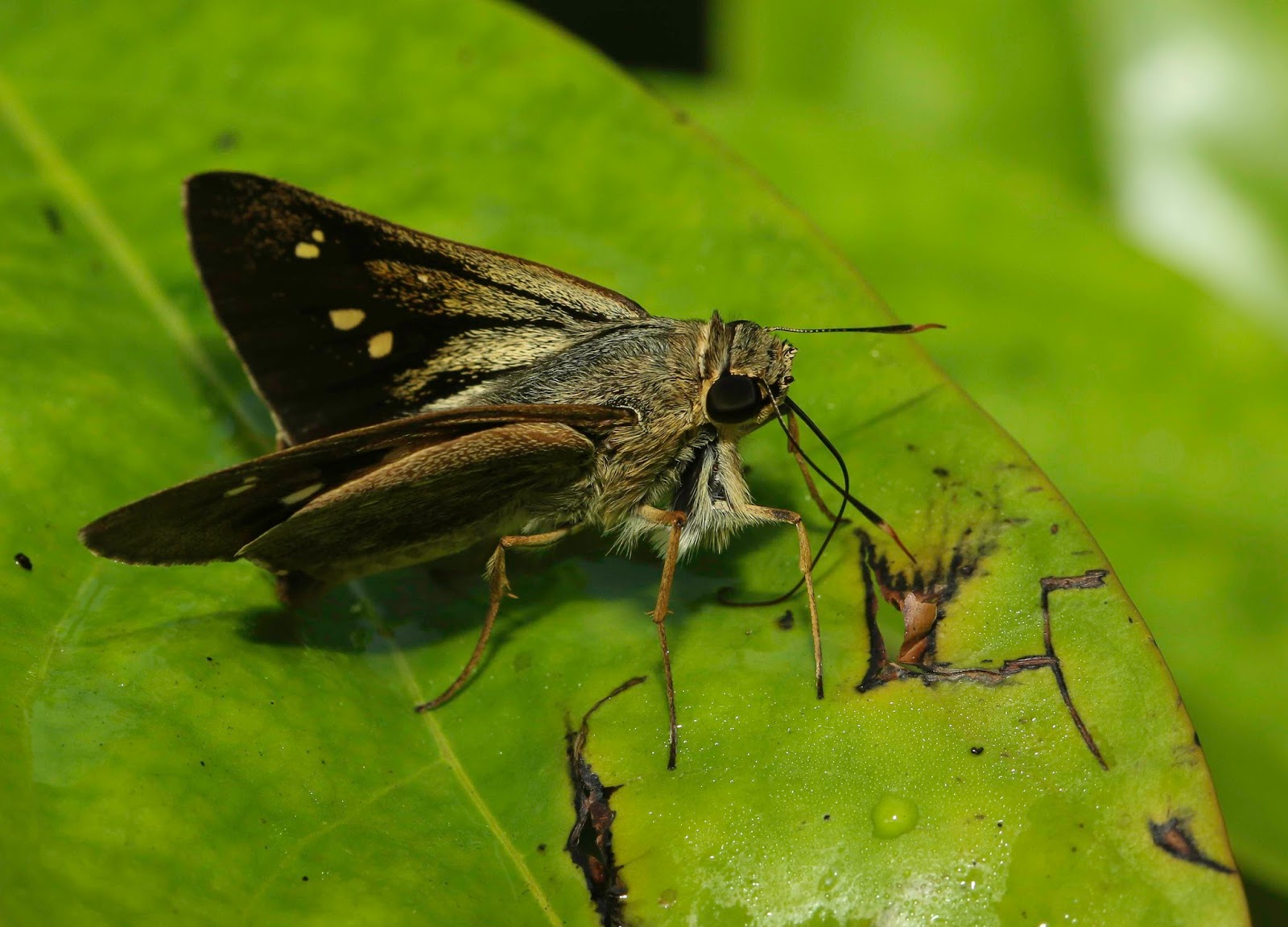
264. Pelopidas assamensis (The Great Swift)

Number: 264
Family: Hesperiidae
Sub-Family: Hesperiinae
Species: Pelopidas assamensis (de Nicéville, 1882)
Common name(s): The Great Swift
Photography location: Ba Vi foothills (Hanoi)

Six species of Pelopidas are currently known to occur in Vietnam viz. agna, mathias, subochracea, conjuncta, sinensis & assamensis. The latter is the largest species of the genus and is therefore quite distinct when seen in the wild.

Pelopidas assamensis, Ba Vi foothills (April 2017)
I'm pretty sure this is the correct ID - unfortunately, I was unable to catch it to examine upperwing pattern

Wednesday, 21 December 2016

226. Matapa sasivarna (The Black-veined Branded Redeye)

Number: 226
Family: Hesperiidae
Sub-Family : Hesperiinae
Species: Matapa sasivarna (Moore, [1866])
Common name(s): The Black-veined Branded Redeye
Photography location: Tam Dao foothills (Vinh Phuc Prov.)


Matapa sasivarna, lower slopes of Tam Dao, 26th October 2016
 Note the extensive metallic green hair scales on body (photos taken without flash).

225. Pirdana hyela rudolphii (The Green-striped Palmer)

Number: 225
Family: Hesperiidae
Sub-Family : Hesperiinae
Species: Pirdana hyela rudolphii Elwes & de Nicéville, [1887]
Common name(s): The Green-striped Palmer
Photography location: Tam Dao foothills (Vinh Phuc Prov.)

Pirdana hyela rudolphii, 13th November 2016

Tuesday, 18 October 2016

207. Matapa aria/druna

Number: 207
Family: Hesperiidae
Sub-Family : Hesperiinae
Species: Matapa aria or M. druna
Common name(s): 
Photography location: Foothills of Tam Dao (Vinh Phuc Prov.)

According to Monastyrskii  & Devyatkin (2016), 4 species of Matapa are recorded from Vietnam: cresta, aria, druna and sasivarna.
M. druna can be easily confused with M. aria, but the male of the former has a large & curved grey brand whereas it is narrow in aria
From the shot below, I am unable to come to a firm identification.

Matapa aria/druna, lower slopes of Tam Dao, 18th Sept. 2016
Despite low-light conditions, this photo was taken without a flash in order not to alter the color of the subject.

Thursday, 18 August 2016

205. Baoris farri (The Bamboo Paintbrush Swift)

Number: 205
Family: Hesperiidae
Sub-Family : Hesperiinae
Species: Baoris farri (Moore, 1878)
Common name(s): The Bamboo Paintbrush Swif
Photography location: Tam Dao foothills (Vinh Phuc Prov.)

Four species of Baoris are recorded from Vietnam: B. farri, B. oceia, B. penicillata, B. pagana.

Baoris farri sunbathing on leaves. Note the spotless hindwing
This quite large skipper is recorded throughout the country

The forewing has hyaline spots in spaces 2-4, 6-8 and 2 cell spots. The female is usually fully spotted and has an additional non-hyaline spot in space 1b on the forewing (visible in this shot). The hindwing does not bear any spot, but the male has a black hair tuft in the cell on top of a scent pouch (hence "Paintbrush" in its common name). 

Tuesday, 2 August 2016

193. Pithauria stramineipennis stramineipennis (The Light Straw Ace)

Number: 193
Family: Hesperiidae
Sub-Family : Hesperiinae
Species: Pithauria stramineipennis stramineipennis Wood-Mason & de Niceville, [1887]
Common name(s): The Light Straw Ace
Photography location: Tam Dao foothills (Vinh phuc Prov.)

This large-sized Hesperid is known to occur from Sikkim to Hainan and south to Sumatra.
Four species of Pithauria are recorded from Vietnam - stramineipennis, linus, murdava and marsena (Monastyrskii & Devyatkin, 2016).


A view of its uppersides showing the cream suffusion on the base of the forewings

192. Thoressa monastyrskyi monastyrskyi (The Monastyrsky's Ace)

Number: 192
Family: Hesperiidae
Sub-Family : Hesperiinae
Species: Thoressa monastyrskyi monastyrskyi Devyatkin, 1996
Common name(s): The Monastyrsky's Ace
Photography location: Tam Dao N.P. (Vinh phuc Prov.)

Thoressa monastyrskyi monastyrskyi is known, at least, from southern China and northern Vietnam. It is replaced further south by T. monastyrskyi annamita Devyatkin & Monastyrskyii, 1999.
All the photos below are from the type locality - Tam Dao (June 2016, alt. 900m asl).

This Thoressa monastyrskyi was feeding on some Bidens flowers along the "Water tank trail".


Friday, 29 July 2016

188. Suastus minuta aditia (The Small Palm Bob)

Number: 188
Family: Hesperiidae
Sub-Family : Hesperiinae
Species: Suastus minuta aditia Evans, 1943
Common name(s): The Small Palm Bob
Photography location : Cat Ba N.P. (Hai Phong City)

Two species of Suastus are recorded from Vietnam - gremius and minuta.

Suastus minuta aditia, Cat Ba Island, secondary forest (July 21th, 2016)

187. Ampittia dioscorides etura (The Bush Hopper)

Number: 187
Family: Hesperiidae
Sub-Family : Hesperiinae
Species: Ampittia dioscorides etura (Mabille, 1891)
Common name(s): The Bush Hopper
Photography location: Cat Ba N.P. (Hai Phong City)

Two species of Ampittia are recorded from Vietnam - dioscorides and virgata. The subspecies A.dioscorides etura is limited to North of the country (and also southern China, Taiwan), and is replaced further south by A.dioscorides camertes.
This small skipper is often seen in abandoned paddy fields.

Ampittia dioscorides etura, Cat Ba Island, secondary forest (July 20th, 2016)


186. Matapa cresta (The Fringed Branded Redeye)

Number: 186
Family: Hesperiidae
Sub-Family : Hesperiinae
Species: Matapa cresta Evans, 1949
Common name(s): The Fringed Branded Redeye 
Photography location: Tam Dao foothills (Vinh Phuc Prov.)

The skipper genus Matapa, described by Moore in 1881 with Ismene aria  Moore, 1866 as the type species, is a small group of the family Hesperiidae. The members of the genus share the following  characters: the eyes are red, wings are dark brown above and below without spots in both sexes, the  hindwing cell at vein M3 is acutely produced, the males of all but M. deprivata  have a stigma on the  upperside of the forewing in spaces Cu1 and Cu2. The genus is comprised of 9 species, which occur  mainly in Oriental region. The species have interesting habits, probably all being mainly crepuscular (de Jong, 1983).
Four species of Matapa are recorded from Vietnam: cresta, aria, druna and sasivarna.

Photo taken without flash - with flash, it really alter its appearance. Lost a lot of sharpness (area very dark, so very high ISO settings) but it doesn't matter, photo looks more natural! Note the extensive pale area on the underside of forewing, distinctly lighter than ground colour. Basal part of hindwing also paler, but less conspicuously

Wednesday, 27 July 2016

185. Koruthaialos rubecula hector (The Narrow-banded Velvet Bob)

Number: 185
Family: Hesperiidae
Sub-Family : Hesperiinae
Species: Koruthaialos rubecula hector Watson, 1893
Common name(s): The Narrow-banded Velvet Bob
Photography location: Cat Ba National Park (Hai Phong City)

The genus Koruthaialos comprises of 4 species, all of which being limited to the Oriental region. In Vietnam 3 are recorded - rubecula, sindu and butleri.
Butleri is unique for the genus in having no oblique orange band on forewing.

Tonkin and S. Annam, respectively, are the type-localities of gopaka Frühst, and avidha Frühst., both synonyms of hector. The subspecific division of rubecula is rather complicated by its individual and seasonal variability and, in particular, by the existence of bandless specimens found occasionally throughout the species range (Evans, 1949)

This species is very closely related to K.sindu. But in sindu the orange band is wider, almost of equal width throughout, and extends as far as the leading edge of the forewings
Moreover the third segment of palpi is short and stout in sindu, long and slender in rubecula

Wednesday, 25 May 2016

175. Scobura parawoolletti (The Divided Forest Bob)

Number: 175
Family: Hesperiidae
Sub-Family : Hesperiinae
Species: Scobura parawoolletti Fan, Chiba & Wang, 2010
Common name(s): The Divided Forest Bob
Photography location: Tam Dao foothills (Vinh Phuc Prov.)

The Vietnamese populations were earlier listed as Scobura woolletti Riley, 1923, a Bornean species, but are most likely similar to the recently described S. Chinese Scobura parawoolletti.

The skipper genus Scobura Elwes & Edwards, 1897 is a small group of Hesperiidae distributed from North India to the Sunda Islands, Indonesia. Xiaoling Fan & al. (2010) recognized 14 species in the genus, of which 9 occur in Vietnam (eximia, phidita, cephala, isota, cephaloides, coniata, tytleri, phuongi, (para)woolletti)

This tiny skipper keeps to the dark undergrowth of forests
Photo taken in natural light. Reacted immediately to the flash and disappeared into the thickets

Monday, 26 October 2015

150. Telicota colon (The Pale Palm Dart)

Number: 150
Family: Hesperiidae
Sub-Family: Hesperiinae
Species: Telicota colon Fabricius, 1775
Common name(s): The Pale Palm Dart, Pale-orange Darter
Photography location: Hanoi City


A male enjoying the autumn sun.


 Male, upperside.

Female, upperside.


Male genitalia
End of clasp broad and rounded.


Illustration of genitalia of different Telicota species (as shown in The Butterflies of The Malay Peninsula, A.S. Corbet and H.M. Pendlebury, 4th Edition).

Sunday, 4 October 2015

140. Iton semamora (The Common Wight)

Number: 140
Family: Hesperiidae
Sub-Family : Hesperiinae
Species: Iton semamora (Moore, [1866])
Common name(s): The Common Wigh
Photography location: Tam Dao foothills (Vinh Phuc Prov.)

Two species of Iton are recorded from Vietnam: I. semamora semamora (N., C. & S.) and I. watsonii (C.).


Tuesday, 8 September 2015

138. Notocrypta curvifascia curvifascia (The Restricted Demon)

Number: 138
Family: Hesperiidae
Sub-Family : Hesperiinae
Species: Notocrypta curvifascia curvifascia (Felder & Felder, 1862)
Common name(s): The Restricted Demon
Photography location: Tam Dao foothills (Vinh Phuc Prov.), Tam Đường District (Lai Chau Prov.)

The genus Notocrypta (the "Demons") comprises 13 species, among them 4 have been recorded in Vietnam: N. paralysos asawa, N. clavata theba, N. curvifascia curvifascia & N. feisthamelii alysos (Monastyrskii & Devyatkin, 2016). All are blackish brown species with an oblique white band and white spot(s) on FW.

Notocrypta curvifascia curvifascia, Tam Dao foothills (July 2016)
FW with subapical spots in spaces 6 to 8, and dots in spaces 3-5

Another specimen from Tam Dao (October 2016)

Same specimen
Note that the FW discal band not continued above the cell to the costal border (unlike N. feisthamelii)

N. curvifascia feeding on Crassocephalum rubens (Lai Chau Prov., January 2017) - more colourful than the individuals I usually see at Tam Dao

Wednesday, 2 September 2015

136. Ancistroides nigrita diocles (The Chocolate Demon)

Number: 136
Family: Hesperiidae
Sub-Family: Hesperiinae
Species: Ancistroides nigrita diocles (Moore, [1866])
Common name(s): The Chocolate Demon
Photography location: Tam Dao foothills (Vinh Phuc Prov.)

Ancistroides nigrita diocles is known from the North and Center of the country, A. nigrita maura from the South (Monastyrskii  & Devyatkin, 2016).


It is a relatively large skipper. On the upperside, the wings are dark brown and unmarked. On the underside, the wings are brown with marginal areas of both wings paler than the ground colour. The proboscis is particularly long compared to other skipper species.
More often found within the shade of the forest but will come to clearings and trails dappled with sunshine.  


Sunday, 30 August 2015

127. Suada albolineata (The Streaky Grass Bob)

Number: 127
Family: Hesperiidae
Sub-Family: Hesperiinae
Species: Suada albolineata Devyatkin, 2000
Common name(s): The Streaky Grass Bob
Photography location: Huu Lien N.R. (Lang Son Prov.), Tam Dao (Vinh Phuc Prov.)

This species is most closely related to S. swerga (De Niceville, [1884]), the upperside pattern of both species being practically identical. Fresh specimens of S. albolineata can be easily distinguished by the strikingly contrasting veins of the underside; for worn specimens examination of the genitalia is helpful.
I have founded this newly described species at Huu Lien and Tam Dao. It seems to be widely distributed all over the country, its distribution thus overlapping with that of its close rela­tive S. swerga (Devyatkin and al., 2003).

ID credit: A.L. Monastyrskii
(Huu Lien N.R.)

 Another individual, from foothills of Tam Dao, basking in the sun in dense forest.

Ditto

A third specimen, from Tam Dao also, photographed on April 2016

References: Devyatkin, A. L. (2000): Hesperiidae of Vietnam, 6. Two new species of the genera Suada de Niceville, 1895 and Quedara Sw inhoe, 1907 (Lepidoptera, Hesperiidae) – PDF here.

Thursday, 27 August 2015

124. Parnara cf. ganga (The Continental Swift)

Number: 124
Family: Hesperiidae
Sub-Family: Hesperiinae
Species: Parnara cf. ganga (Evans, 1937)
Common name(s): The Continental Swift
Photography location: Huu Lien Nature Reserve (Lang Son Prov.)

Five Parnara species are listed by Monastyrskii & Devyatkin (2016) from Vietnam viz P. apostata, P. bada, P. ganga, P. batta and P. guttata. The latter flies from China, Korea and Japan to Himalaya and central Asia. 

Parnara species show a great similarity of the external features and it is very difficult to determine with certainty the species only from a photograph. For proper identification, it is better to voucher the specimen to have a complete view of the FW and HW pattern (often incomplete in a shot) and, ideally, to confirm the ID by examination of the genitalia - a matter for specialists.
In the females, the size and spotting pattern are highly variable, this making most of the species almost indistinguishable by the external features. 

Photographed in open agricultural land

A close-up view of the forewing (FW) upperside, illustrating post-discal spots in spaces 2-4, 6-7, no cell spots. Hindwing (HW) discal spots in spaces 2-5 large, spot 6 absent.
FW 13 mm in this specimen

P. guttata is larger (FW 15-19 mm),with both FW cell spots present.
P. apostata is much darker.
In P. bada, HW spots in spaces 2-5 small and irregular and may be absent.

Another supposed Parnara ganga from Mt. Tam Dao (foothills, open area).
Note the position of wings : usually for a Hesperiine, the adults commonly bask with the forewings held at a 45° angle, and the hindwings held flat.
   
References : A revision of the genus Parnara Moore (Lepidoptera, Hesperiidae), with special reference to the Asian species (Chiba & Eliot, 1991) PDF here.

Wednesday, 26 August 2015

123. Borbo cinnara (The Rice Swift)

Number: 123
Family: Hesperiidae
Sub-Family: Hesperiinae
Species: Borbo cinnara (Wallace, 1866)
Common name(s): The Rice Swift, The Formosan Swift
Photography location: Huu Lien N.R. (Lang Son Prov.)

B. cinnara show ochreous or dull yellow-brown underside, with greenish body hairs.
The hindwing has whitish spots in spaces 2-4 and 6, no cell spot. The spot in space 4 is typically small or even absent (this is the case here).

Borbo cinnara always have a spot 1b in both sexes on the upperside - absent or faint in Pseudoborbo bevani.

119. Pelopidas sp.

Number: 119
Family: Hesperiidae
Sub-Family: Hesperiinae
Species: Pelopidas sp.
Common name(s):
Photography location: Cuc Phuong N.P. (Ninh Binh Prov.)

Note underside HW with central cellspot.