Showing posts with label Papilioniinae. Show all posts

Saturday, 18 March 2017

259. Atrophaneura aidoneus aidoneus (The Lesser Batwing)

Number: 259
Family: Papilioniidae
Sub-Family: Papilioniinae
Species: Atrophaneura aidoneus aidoneus (Doubleday, 1845)
Common name(s): The Lesser Batwing
Photography location: Huu Lien Nature Reserve (Lang Son Prov.)

"Red-bodied Swallowtails" are butterflies in the Papilionidae that belong to the genera Atrophaneura (3 species in Vietnam), Byasa (8), Losaria (1) and Pachliopta (1). Many species show aposematism (“warning coloration”) and serve as models for Batesian mimicry.

The genus Atrophaneura comprises around 50 species, of which 3 are currently known to occur in Vietnam - A. zaleucus zaleucus, A. varuna astorion & A. aidoneus aidoneus
A. varuna and A. aidoneus show very similar color pattern. A. zaleucus (previously treated as subspecies of A. varuna) is unmistakable with its white patches on HW.

Atrophaneura aidoneus, male, feeding feeding in Lantana thickets adjacent to forest (Huu Lien, October 2016)

 Same specimen than above
In both sexes of  A. aidoneus the upperside HW is uniformly coloured, where in all subspecies of A. varuna the cell is obviously darker than the rest of the hindwing (Cotton & Racheli, 2006)

Upperside of 2 specimens of A. varuna astorion for comparison (Huu Lien, October 2016)

Sunday, 22 January 2017

240. Chilasa paradoxa telearchus (The Great Mime)

Number: 240
Family: Papilioniidae
Sub-Family: Papilioniinae
Species:  Chilasa paradoxa telearchus (Hewitson, 1852)
Common name(s): The Great Mime 
Photography locations: Tam Dao foothills (Vinh Phuc Prov.), Cuc Phuong N.P. (Ninh Binh Prov.)

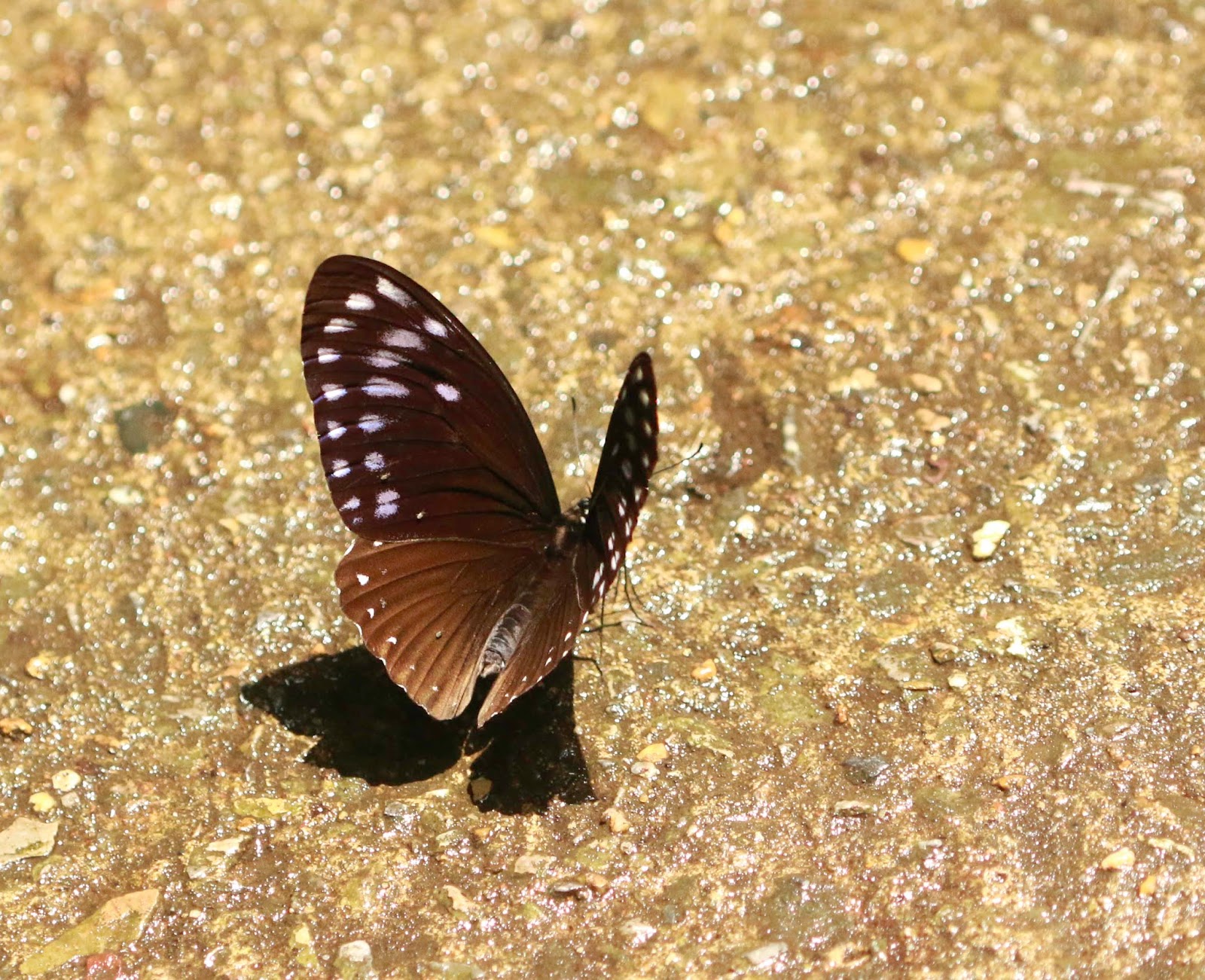
During a trip at Tam Dao foothills I bumped into an Euploea butterfly that, well, didn't sit right. Sadly, I had forgotten my net and was unable to capture it for closer examination but I managed to get a record shot. When I returned home I did a little digging and it turns out to be Chilasa paradoxa. Until now it has eluded me. 

Monastyrskii & Devyatkin (2016) listed 6 Chilasa species in Vietnam viz. agestor, epycides, slateri, clytia, paradoxa and imitata - the last one described in 2003 from central Vietnam.
Chilasa paradoxa telearchus is an excellent mimic of the Danaid Euploea mulciber.

Chilasa paradoxa telearchus on a rock by a stream at Tây Thiên (Tam Dao foothills, August 29, 2016)
Note the UpF with end cell spot, the regular rows of elongate postdiscal bluish spots and submarginal spots

Note also the curved, robust clubbed antennae - very different from that of an Euploea species

Another specimen, from Cuc Phuong, May 2017

Tuesday, 17 January 2017

238. Graphium eurypylus cheronus (The Great Jay)

Number: 238
Family: Papilioniidae
Sub-Family: Papilioniinae
Species: Graphium eurypylus cheronus (Fruhstorfer, [1903])
Common name(s): The Great Jay 
Photography locations: Xuan Son N.P. (Phu Tho Prov.), Tam Dao (Vinh Phuc Prov.)

With at least 104 species, Graphium is the second largest genus in the Papilioniidae family - the first one being Papilio with around 210 species. But unlike Papilio, no Graphium species are known from the Neotropical and Nearctic ecozones. 
Monastyrskii & Devyatkin (2016) listed 20 Graphium species recorded in Vietnam viz. cloanthus, sarpedon, doson, evemon, eurypylus, chironides, leechi, arycles, agamemnon, phidias, macareus, megarus, xenocles, agetes, antiphates, aristeus, nomius, mullah, mandarinus, eurous.

Graphium eurypylus is one of the most wide-ranging Graphium - from India to Australia, range similar to that of G. agamemnon and G. sarpedonMany subspecies have been described,  G. e. cheronus is known from Sikkim to Indo-China, South China.
G. eurypylus is my 8th Graphium species seen in Vietnam.

Graphium eurypylus (center of the pic) and Graphium doson axion (+ some Appias albina) puddling on a sandy river bank at Xuan Son N.P. (August 2016)
 
Graphium eurypylus is distinguished from the very similar G. doson by the black bar holding the red spot in S8 on the underside of the hindwing joining the black anal submarginal stripe near the base of the cell in a Y. In G. doson this black bar is clearly separate from the black submarginal stripe

Graphium eurypylus puddling with Appias galba and Appias albina (+ blurry Ixias pyrene in the top left corner) Cuc Phuong, July 2016


A nice variety of puddling butterflies at Xuan Son National Park - June 2014
 1 Graphium antiphates (Fivebar Swordtail), 2 Papilio nephelus chaon (Yellow Helen), 3 Papilio protenor euprotenor (Spangle), 4 Hebomoia glaucippe (Great Orange Tip), 5 Appias galba (Indian Orange Albatross), 6 Vindula erota (Common Cruiser), 7 Cepora nadina (Lesser Gull), 8 Prioneris thestylis (Spotted Sawtooth), 9 Appias lyncida (Chocolate Albatross), 10 Graphium sarpedon (Common Bluebottle), 11 Graphium eurypylus (Great Jay), 12 Graphium chironides (Veined Jay), 13 Papilio memnon (Great Mormon)


If you look closely at this image you can see 5 Graphium species (1 eurypylus, 2 chironides, 3 sarpedon, 4 doson, 5 antiphates), 4 Papilio species (6 polytes, 7 memnon, 8 nephelus chaon, 9 protenor euprotenor) and 4 Pierid species (10 Cepora nerissa, 11 Appias lyncida, 12 Appias albina, 13 Prioneris thestylis)  


Puddle party at water seepage on a rocky slope at a riverbank (Tam Dao foothills, mid-June 2016) with 5 Papilio species (1 nephelus chaon, 2 helenus, 3 bianor gladiator, 4 polytes, 5 memnon) + Graphium eurypylus cheronus (6)

Another puddle party, from Cuc Phuong (July 2016), with 4 Graphium species (1 eurypylus, 2 macareus, 3 doson, 4 antiphates), 5 Pierid species (5 Appias albina, 6 A. galba, 7 A. indra, Catopsilia pomona, 9 Prioneris thestylis)

Mud-puddling is one of the most fascinating butterfly behaviour to watch, especially in protected areas where hundreds sometimes thousands of individuals gathering at wet places. Not all butterflies species gather at mud puddles and it is a behaviour that is still not fully understood. The majority of specimens found near mud are males and quite often, while the butterfly blokes are drinking from the mud, fluids are pumped out of their abdomens.

It is believed that butterflies congregate on mud and other such substances primarily for salts. The salts and amino acids absorbed during mud-puddling play various roles in butterfly ecology, ethology and physiology. Males seem to benefit more from the sodium uptake as it aids in reproductive success, with the precious nutrients often transferred to the female during mating. This extra nutrition helps ensure that the eggs survive.

Typically, mud-puddling behavior takes place on wet soil. But even sweat on human skin or clothes may be attractive to butterflies.

Sunday, 19 June 2016

178. Papilio dialis doddsi (The Southern Chinese Peacock)

Number: 178
Family: Papilioniidae
Sub-Family: Papilioniinae
Species: Papilio dialis doddsi Jannet, 1896
Common name(s): The Southern Chinese Peacock
Photography location: Tam Dao foothills (Vinh Phuc Prov.)

Papilio dialis has been recorded from Myanmar, Laos, Vietnam, southern China, Taiwan (? Thailand). To my knowledge, the race doddsi is only known from Vietnam (N. & C.) and Laos. It is sometimes raised to specific rank by some authors (Papilio doddsi Jannet, 1896).

Papilio dialis doddsi belongs to the subgenus Achillides ("Peacocks Swallowtails"). The other representants of this subgenus known in Vietnam are P. paris paris, P. arcturus arcturus, P. krishna charlesi & P. bianor gladiator.

Two males of Papilio dialis doddsi puddling on rocks near the main stream at Tây Thiên, foothills of Tam Dao, on June 18, 2016. These are typical dialis doddsi from northern Vietnam, but some can have longer tails

This nice Swallowtail is rather local in distribution and is also a very short-lived species, so if you are not in the right place at the right time you won't see it

Male Papilio dialis doddsi sucking water on rocks along a stream (Tam Dao foothills, June 2016)

Friday, 17 June 2016

177. Papilio bianor gladiator (The Chinese Peacock)

Number: 177
Family: Papilioniidae
Sub-Family: Papilioniinae
Species: Papilio bianor gladiator Fruhstorfer, 1901
Common name(s): The Chinese Peacock
Photography location: Tam Dao (Vinh Phuc Prov.), Ba Vi N.P. (Hanoi) foothills

Papilio bianor is found in north-east India, Burma, Laos, Thailand, Vietnam (N. & C.), South Korea, China, Taiwan and Japan.
Papilio bianor gladiator was described by Fruhstorfer from Chiem Hoa, Tonkin [= northern Vietnam]. This taxon is recorded from Sikkim, Assam to N.Myanmar, N.Thailand, Laos, Vietnam (N. & C.), S.China.

Male Papilio bianor gladiator at water seepage on a rocky slope at a riverbank (Tam Dao, mid-June 2016)

Zoom out to show the entire puddle party with 5 Papilio species (1 nephelus chaon, 2 helenus, 3 bianor gladiator, 4 polytes, 5 memnon) + Graphium eurypylus cheronus (6)

Can be confused with P. dialis doddsi (or P. doddsi for some authors). Apart from the fully developed tails (most Vietnamese dialis are tailless or with small stumpy tails) there are several other characters. Note the lines of male androconial scales near the tornus of the forewing upperside are merged together, in P. dialis they are separate. Also the red and pink submarginal lunules on the hindwing underside are very different in dialis, and the basal half of the forewing underside in bianor is usually much darker than the apex, whereas in dialis there is less difference (Adam Cotton, pers. comm.).

Another male specimen, from Ba Vi this one, photographed in December 2016:

Papilio bianor gladiator on Lantana camara - an extremely popular nectar source for a wide variety of butterflies

A rather worn specimen - this is the problem with winter trips!

Many thanks to Adam Cotton for the information and ID help.

Monday, 15 February 2016

162. Lamproptera meges (The Green Dragontail)

Number: 162
Family: Papilioniidae
Sub-Family: Papilioniinae
Species: Lamproptera meges Zincken, 1831
Common name(s): The Green Dragontail
Photography location: Cuc Phuong N.P. (Ninh Binh Prov.)

In flight it can hardly be recognized as a butterfly; when circling low looking for a drinking spot they look like dragonflies. 

Hundreds of Lamproptera species (mostly meges) demonstrating selectively gregarious behavior when mud-puddling along a dirt road in Xuan Son NP
I was amazed to see so many butterflies packed into such a small area

Lamproptera species tend to puddle separately from aggregations of other species. Lamproptera meges is usually by far the commoner of the two species where both occur together

Lamproptera meges
There are several key features that can help naturalists confidently separate the different species of Lamproptera - see L. curius's post

Lamproptera meges

Lamproptera meges

Lamproptera meges

Lamproptera meges mudpuddling with Graphium doson (Common Jay) and Graphium eurypylus (Great Jay / half-hidden)

161. Lamproptera curius (The White Dragontail)

Number: 161
Family: Papilioniidae
Sub-Family: Papilioniinae
Species: Lamproptera curius Fabricius, 1787
Common name(s): The White Dragontail
Photography location: Cuc Phuong N.P. (Ninh Binh Prov.), Tam Dao (Vinh Phuc Prov.)

Males of species of Lamproptera frequent open riverbanks in forests. They tend to puddle separately from aggregations of other species, often being found on sand nearby rather than in a multi-species group. They look like dragonflies when flying along a stream bed, and can easily be overlooked by an observer unless they alight on the bank.

 Lamproptera curius


Lamproptera meges can be distinguished from curius by the forewing discal band, green in meges and white in curius. They can also be separated by examining the dark band outside this paler discal band. In meges the green band is contiguous with the dark band across the whole forewing, whereas in curius there is a narrow transparent band separating the white and dark bands below the forewing cell.

The two species of Lamproptera also have other characters to separate them, particularly the white androconial scales in the anal margin of the hindwing of the male of curius, which are absent in meges, and the green scales at the tip of the antennae of meges, absent in curius.
The larval foodplants of both species of Lamproptera are species of Illigera (Hernandiaceae).

Until recently, only two species of  Lamproptera were known. But in 2014, a new species has been described from northern Yunnan, China : L. paracurius.

Key to species of Lamproptera based on external characters (from Hu, Zhang, Cotton & Ye, 2014):

1     Forewing inner discal band white; a hyaline band at least 1 mm wide between the black and white bands . . . . 2
-      Forewing inner discal band pale green (or with a blue hue, colour more vivid when alive); no obvious hyaline band between the black and pale green bands . . . . . . . . . . . . 
. . .. . . . . . .  . . . .  . .   L. meges

2      Forewing black marginal band edged proximally with white. . . . . . . . . . . . . . . . . L. paracurius
-       Forewing black marginal band not edged proximally with white. . . . . . . . . . . .  . .L. curius


The range of Lamproptera curius is from India, east to China, south through Indochina and Malay Peninsula, Sumatra and Borneo and Palawan island. White Dragontail is the smallest swallowtail butterfly in the whole Papilionidae family. 

Lamproptera curius


Lamproptera curius


Lamproptera curius feeding on Bidens flowers

Thursday, 4 February 2016

156. Troides aeacus (The Golden Birdwing)

Number: 156
Family: Papilioniidae
Sub-Family: Papilioniinae
Species: Troides aeacus (C. & R. Felder, 1860)
Common name(s): The Golden Birdwing
Photography location: Tam Dao foothills (Vinh Phuc Prov.)

This is the commoner species of Troides, occurring throughout the country in a wide variety of habitats and altitudes, even being present in towns. 
This species can easily be distinguished from Troides helena in the male by the more acute anal angle of the hindwing, and the peppering of black scales at the edge of the golden yellow discal patch near the anal angle, which is not found in helena
The females can be separated by examining the black markings at the base of the hindwing. In aeacus this extends into the hindwing below the cell, whereas in helena it fills space 7 but does not enter space 1 below the cell. The female of aeacus also has a yellow discal spot in space 7 of the hindwing, which is absent in helena.
Below some shots of a female caught in July 2015 at Tam Dao (Tây Thiên). I haven't took photo of male yet.

 Female Troides aeacus

Same individual in hand, close-up on underside HW
Note the yellow discal spot in space 7 (absent in helena) and the black coloration in space 1 below the cell (yellow in helena).


Underside HW of female helena, for comparison.

Wednesday, 3 February 2016

154. Graphium chironides chironides (The Veined Jay)

Number: 154
Family: Papilioniidae
Sub-Family: Papilioniinae
Species: Graphium chironides (Honrath, 1884)
Common name(s): The Veined Jay
Photography location: Xuân Son N.P. (Phu Tho Prov.)

Monastyrskii & Devyatkin (2016) listed 20 Graphium species recorded in Vietnam viz. cloanthus, sarpedon, doson, evemon, eurypylus, chironides, leechi, arycles, agamemnon, phidias, macareus, megarus, xenocles, agetes, antiphates, aristeus, nomius, mullah, mandarinus, eurous.

Graphium chironides ranges from Nepal to Malaysia. It is a pretty Papilionid that is often seen mud-puddling with other Bluebottles and Jays.

A nice variety of puddling butterflies at Xuan Son National Park in June 2014
1 Graphium antiphates (Fivebar Swordtail), 2 Papilio nephelus chaon (Yellow Helen), 3 Papilio protenor euprotenor (Spangle), 4 Hebomoia glaucippe (Great Orange Tip), 5 Appias galba (Indian Orange Albatross), 6 Vindula erota (Common Cruiser), 7 Cepora nadina (Lesser Gull), 8 Prioneris thestylis (Spotted Sawtooth), 9 Appias lyncida (Chocolate Albatross), 10 Graphium sarpedon (Common Bluebottle), 11 Graphium cf. eurypylus (Great Jay), 12 Graphium chironides (Veined Jay), 13 Papilio memnon (Great Mormon)

 If you look closely at this image you can see 5 Graphium species (1 eurypylus, 2 chironides, 3 sarpedon, 4 doson, 5 antiphates), 4 Papilio species (6 polytes, 7 memnon, 8 nephelus chaon, 9 protenor euprotenor) and 4 Pierid species (10 Cepora nerissa, 11 Appias lyncida, 12 Appias albina, 13 Prioneris thestylis)

Graphium chironides is easily distinguished from other Graphium species by the orange, rather than red spots on the hindwing underside. However, in the mountains of far North Vietnam (particularly Lao Cai and Ha Giang Provinces), can easily be mistaken for G. leechi.


Graphium chironides with Graphium xenocles (Great Zebra)

153. Graphium xenocles kephisos (The Great Zebra)

Number: 153
Family: Papilioniidae
Sub-Family: Papilioniinae
Species: Graphium xenocles kephisos (Fruhstorfer, 1902)
Common name(s): The Great Zebra
Photography location: Cuc Phuong N.P. (Ninh Binh Prov.)

Monastyrskii & Devyatkin (2016) listed 20 Graphium species recorded in Vietnam viz. cloanthus, sarpedon, doson, evemon, eurypylus, chironides, leechi, arycles, agamemnon, phidias, macareus, megarus, xenocles, agetes, antiphates, aristeus, nomius, mullah, mandarinus, eurous.

Graphium xenocles ranges from Bhutan to Thailand. The subspecies indochinensis inhabits Thailand, N. Laos, N. and C. Vietnam, S. China.

Both sexes exhibit a flight pattern similar to the Danainae models which they mimic, slow and seemingly unafraid; but, unlike the models, will fly away quickly if disturbed.

A male Graphium xenocles puddling with two Red Helen (Papilio helenus) and a Spotted Sawtooth (Prioneris thestylis)

Same individual with Prioneris thestylis


Graphium xenocles with Graphium chironides

Graphium xenocles can be distinguished from the rather similar species macareus by the presence of an orange-yellow spot on the anal angle of the hindwing, and its usually larger size.

A distant but interersting shot of Graphium macareus (right) side by side with G. xenocles (Cuc Phuong, July 2016)
Males xenocles beat their forewings while puddling, unlike macareus, which sit on the mud with wings closed

Monday, 12 October 2015

149. Papilio nephelus chaon (The Yellow Helen)

Number: 149
Family: Papilioniidae
Sub-Family: Papilioniinae
Species: Papilio nephelus chaon Westwood,1845
Common name(s): The Yellow Helen
Photography location: Cuc Phuong N.P. (Ninh Binh Prov.)


Papilio nephelus chaon superficially closely resembles P. helenus but the latter is smaller and has red submarginal lunules on the underside hindwings, whereas these are yellowish-orange in nephelus. Moreover, the HW upper discal white patch is larger in nephelus, formed of elongate broad streaks in interspaces 4 to 7 (5 to 7 in helenus).


Congregation of mudpuddling Papilio species - protenor (1 in flight), polytes, nephelus, helenus (hiddden) - + 1 Prioneris thestylis 

Two Spangle Papilio protenor euprotenor mudpuddling with a Yellow Helen

Papilio protenor euprotenorP. polytes and P. nephelus (1 in flight on the right corner)

Yellow Helen with Spangle Papilio protenor euprotenor,  Little Map Cyrestis themire and Yellow Orange Tip Ixias pyrene (in flight)

Upperside view of Papilio nephelus chaon
 This species is easily recognisable by the white hindwing patch reaching across four spaces, rather than only three as in helenus. The submarginal lunules on the hindwing underside are ochre yellow or cream rather than red, but are highly variable in size, from totally absent to fully developed lunules in all interspaces

A specimen resting on a fern - the white patch is hidden by the FW


Papilio nephelus chaon courtship (July 2016, Tam Dao)

Papilio nephelus mudpuddling with P. helenus and P. protenor


Another puddle party (water seepage on a rocky slope at a riverbank, Tam Dao, mid-June 2016) with 5 Papilio species (1 nephelus chaon, 2 helenus, 3 bianor gladiator, 4 polytes, 5 memnon) + Graphium eurypylus cheronus (6)

Four species of Papilionidae puddling together: Chilasa clythia, Papilio polytes, Papilio nephelus chaon, Graphium doson


Two P. nephelus chaon (background) puddling with P. polytes and Papilio helenus