Showing posts with label Papilio. Show all posts

Sunday, 19 June 2016

178. Papilio dialis doddsi (The Southern Chinese Peacock)

Number: 178
Family: Papilioniidae
Sub-Family: Papilioniinae
Species: Papilio dialis doddsi Jannet, 1896
Common name(s): The Southern Chinese Peacock
Photography location: Tam Dao foothills (Vinh Phuc Prov.)

Papilio dialis has been recorded from Myanmar, Laos, Vietnam, southern China, Taiwan (? Thailand). To my knowledge, the race doddsi is only known from Vietnam (N. & C.) and Laos. It is sometimes raised to specific rank by some authors (Papilio doddsi Jannet, 1896).

Papilio dialis doddsi belongs to the subgenus Achillides ("Peacocks Swallowtails"). The other representants of this subgenus known in Vietnam are P. paris paris, P. arcturus arcturus, P. krishna charlesi & P. bianor gladiator.

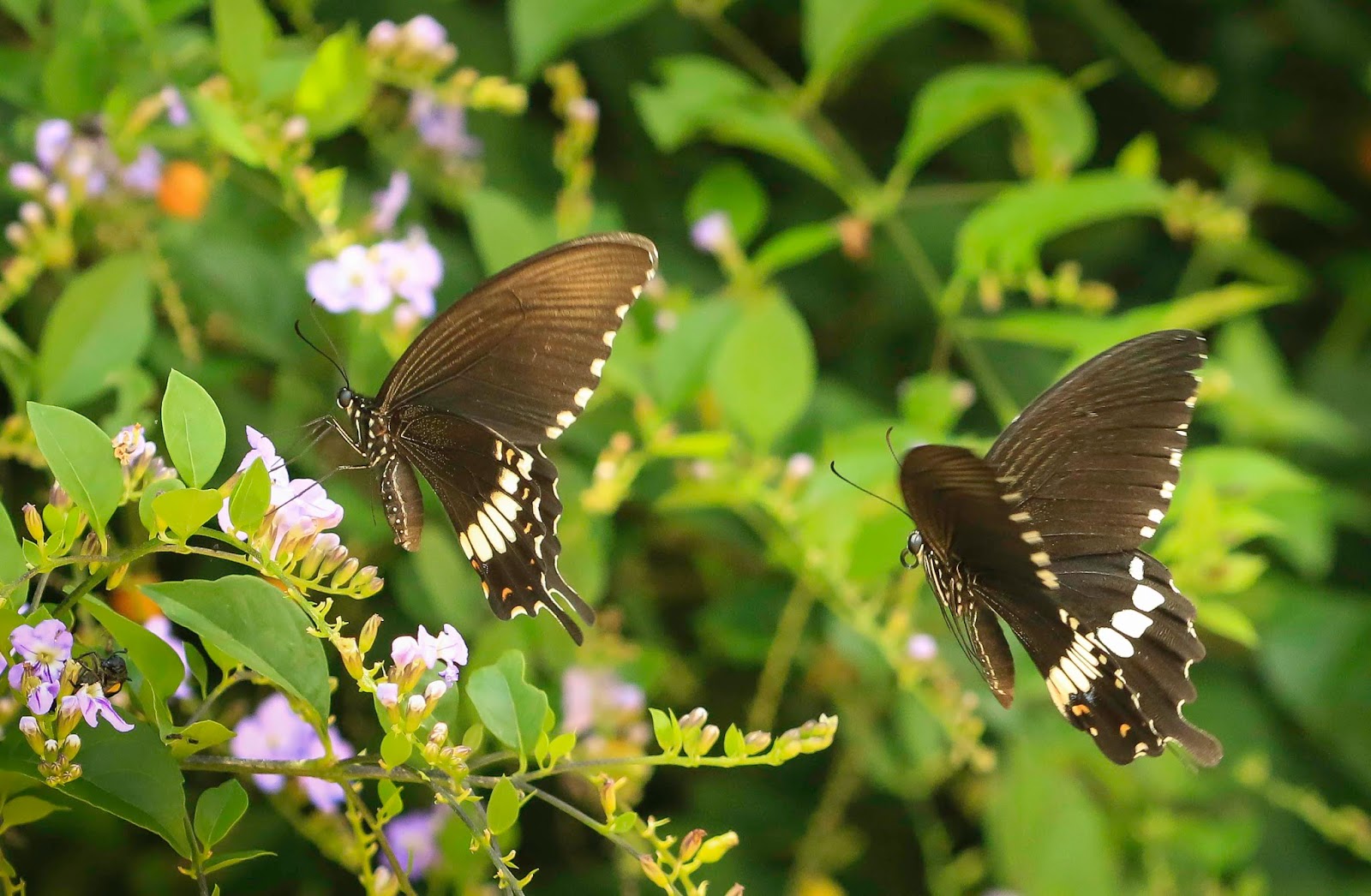
Two males of Papilio dialis doddsi puddling on rocks near the main stream at Tây Thiên, foothills of Tam Dao, on June 18, 2016. These are typical dialis doddsi from northern Vietnam, but some can have longer tails

This nice Swallowtail is rather local in distribution and is also a very short-lived species, so if you are not in the right place at the right time you won't see it

Male Papilio dialis doddsi sucking water on rocks along a stream (Tam Dao foothills, June 2016)

Friday, 17 June 2016

177. Papilio bianor gladiator (The Chinese Peacock)

Number: 177
Family: Papilioniidae
Sub-Family: Papilioniinae
Species: Papilio bianor gladiator Fruhstorfer, 1901
Common name(s): The Chinese Peacock
Photography location: Tam Dao (Vinh Phuc Prov.), Ba Vi N.P. (Hanoi) foothills

Papilio bianor is found in north-east India, Burma, Laos, Thailand, Vietnam (N. & C.), South Korea, China, Taiwan and Japan.
Papilio bianor gladiator was described by Fruhstorfer from Chiem Hoa, Tonkin [= northern Vietnam]. This taxon is recorded from Sikkim, Assam to N.Myanmar, N.Thailand, Laos, Vietnam (N. & C.), S.China.

Male Papilio bianor gladiator at water seepage on a rocky slope at a riverbank (Tam Dao, mid-June 2016)

Zoom out to show the entire puddle party with 5 Papilio species (1 nephelus chaon, 2 helenus, 3 bianor gladiator, 4 polytes, 5 memnon) + Graphium eurypylus cheronus (6)

Can be confused with P. dialis doddsi (or P. doddsi for some authors). Apart from the fully developed tails (most Vietnamese dialis are tailless or with small stumpy tails) there are several other characters. Note the lines of male androconial scales near the tornus of the forewing upperside are merged together, in P. dialis they are separate. Also the red and pink submarginal lunules on the hindwing underside are very different in dialis, and the basal half of the forewing underside in bianor is usually much darker than the apex, whereas in dialis there is less difference (Adam Cotton, pers. comm.).

Another male specimen, from Ba Vi this one, photographed in December 2016:

Papilio bianor gladiator on Lantana camara - an extremely popular nectar source for a wide variety of butterflies

A rather worn specimen - this is the problem with winter trips!

Many thanks to Adam Cotton for the information and ID help.

Monday, 12 October 2015

149. Papilio nephelus chaon (The Yellow Helen)

Number: 149
Family: Papilioniidae
Sub-Family: Papilioniinae
Species: Papilio nephelus chaon Westwood,1845
Common name(s): The Yellow Helen
Photography location: Cuc Phuong N.P. (Ninh Binh Prov.)


Papilio nephelus chaon superficially closely resembles P. helenus but the latter is smaller and has red submarginal lunules on the underside hindwings, whereas these are yellowish-orange in nephelus. Moreover, the HW upper discal white patch is larger in nephelus, formed of elongate broad streaks in interspaces 4 to 7 (5 to 7 in helenus).


Congregation of mudpuddling Papilio species - protenor (1 in flight), polytes, nephelus, helenus (hiddden) - + 1 Prioneris thestylis 

Two Spangle Papilio protenor euprotenor mudpuddling with a Yellow Helen

Papilio protenor euprotenor, P. polytes and P. nephelus (1 in flight on the right corner)

Yellow Helen with Spangle Papilio protenor euprotenor,  Little Map Cyrestis themire and Yellow Orange Tip Ixias pyrene (in flight)

Upperside view of Papilio nephelus chaon
 This species is easily recognisable by the white hindwing patch reaching across four spaces, rather than only three as in helenus. The submarginal lunules on the hindwing underside are ochre yellow or cream rather than red, but are highly variable in size, from totally absent to fully developed lunules in all interspaces

A specimen resting on a fern - the white patch is hidden by the FW


Papilio nephelus chaon courtship (July 2016, Tam Dao)

Papilio nephelus mudpuddling with P. helenus and P. protenor


Another puddle party (water seepage on a rocky slope at a riverbank, Tam Dao, mid-June 2016) with 5 Papilio species (1 nephelus chaon, 2 helenus, 3 bianor gladiator, 4 polytes, 5 memnon) + Graphium eurypylus cheronus (6)

Four species of Papilionidae puddling together: Chilasa clythia, Papilio polytes, Papilio nephelus chaon, Graphium doson


Two P. nephelus chaon (background) puddling with P. polytes and Papilio helenus

Saturday, 10 October 2015

148. Papilio polytes polytes (The Common Mormon)

Number: 148
Family: Papilioniidae
Sub-Family: Papilioniinae
Species: Papilio polytes polytes Linnaeus 1758
Common name(s): The Common Mormon
Photography locations: Hanoi City, Tam Dao foothills (Vinh Phuc Prov.)

Papilio polites ranges widely from Sri Lanka and India to Indo-China, S. Japan, the Philippines and Sunda Islands in SE Asia. Its caterpillars feed on a variety of Rutaceae plants (Citrus and allied genera, including lemon and orange plants) and the butterfly is palatable to its predators such as birds. Various female forms of this species derive protection from such predators with their resemblance to distantly related, chemically protected (toxic) red-bodied Swallowtails, which experienced birds avoid eating. This type of resemblance is called Batesian mimicry, which is restricted in P. polytes to females, and the toxic species they resemble are called "models". 

Non-mimetic (form cyrus) females look like males, whereas mimetic female morphs (forms stichius, polytes, romulus...) mimic distantly related, toxic Pachliopta swallowtails.

Male Papilio polytes

The Common Mormon can be found in both natural and urban areas - cultivated Citrus has ensured this. Males and females can often be seen feeding at flowers. Males are also commonly found mud-puddling in lowland forests.
In Vietnam, two subspecies have been recorded : P. polytes polytes (Sino-Japanese taxon: N. Vietnam to Japan) and P. polytes romulus (Indomalayan taxon: C. and S. Vietnam, + Thailand, Malaisia, Laos, India...).


♀ form stichius resemble the unpalatable butterfly Pachliopta aristolochiae, and is able to avoid predators as a result. © 2015 Haruhiko Fujiwara.

Common Mormon courtship. Female (on the left) display the non-mimetic form cyrus


The courtship 'dance' of this species is particularly beautiful. The male appears to mob the female, until she eventually settles on a plant to forage on flowers, fluttering her wings. The male hovers continuously around her, occasionally butting her. The female then takes off, flies upwards to a next flower with the male following, facing her at all times.

Papilio polytes can be easily distinguished from the similar prexaspes by the presence of white marginal spots up the forewing from the tornus

The female of the non-mimetic form cyrus


The male. In Tonkin, different forms are known (pammon, borealis, depictus...) but none is mimetic

The female form stichius which mimics the Common Rose Pachliopta aristolochiae 
but with an entirely black abdomen


Female form stichius, upperside 
Note the central and large white patch (confined to anterior portion of HW in P. helenus)


Another mimetic female


Papilio polytes courtship, with the female displaying the stichius form


 Female form stichius followed by 2 courting males


A puddle party of Papilio polytes


 P. polytes puddling with Papilio helenus (foreground) and 2 P. nephelus chaon 


Papilio polytes, 3th or 4th instar caterpillar showing osmeterium
This Y-shaped eversible gland located mid-dorsally behind the head, is a universal characteristic of  swallowtail caterpillars (Papilionidae).

Old Vietnamese stamp bearing the image of Papilio polytes stichius

Friday, 9 October 2015

147. Papilio helenus helenus (The Red Helen)

Number: 147
Family: Papilioniidae
Sub-Family: Papilioniinae
Species: Papilio helenus helenus Linnaeus, 1758
Common name(s): The Red Helen
Photography location: Hanoi City

Large, black-bodied and tailed swallowtail with white patches extending into three cells in both the upper and underside of the hindwings with a chain of small red spots at its outer edge. The underside of the forewing is dark-brown with many white to yellow linear markings.  

Papilio helenus is found commonly throughout the year in forested habitats across Vietnam, but does not usually venture out into cultivated land and towns. This butterfly is easily distinguished from similar species in Vietnam by the row of bright red submarginal lunules on the underside of the hindwings.

Papilio helenus courtship. Sexes very similar
Female (on top) larger, more red spots at HW outer edge


The female, upperside

The female, underside

Close-up on the UnH (female)
More or less quadrate white spot in space 7, with 2 more elongate similar spots in spaces 5 and 6 that form a conspicuous upper discal white patch, the outer margin of which is zigzag. 
This white patch of 3 spots in spaces 5-7 is a characteristic feature of both sexes.

Male in flight

Same specimen

A female resting on a leaf - the white patch is hidden by the FW

Males Papilio helenus puddling with P. polytes and 2 P. nephelus chaon
Female Papilionidae do mud-puddle occasionally, especially ones that have just hatched from the pupa and want a drink of fresh water. They do not congregate with the males at urine/salts/faeces, only at plain water. Here in SE Asia it is quite a rare event to see a female Papilio at mud or sandy stream banks. On the other hand, some Pierid females are often found in some numbers mud-puddling at urine mixed in with males, especially Catopsilia pomona and Appias species


Another puddle party (water seepage on a rocky slope at a riverbank, Tam Dao, mid-June 2016) with 5 Papilio species (1 nephelus chaon, 2 helenus, 3 bianor gladiator, 4 polytes, 5 memnon) + Graphium eurypylus cheronus (6)

Thursday, 8 October 2015

146. Papilio memnon agenor (The Great Mormon)

Number: 146
Family: Papilioniidae
Sub-Family: Papilioniinae
Species: Papilio memnon agenor Linnaeus, 1758
Common name(s): The Great Mormon
Photography locations: Hanoi City, Ba Vi N.P. (Hanoi)

Papilio memnon is a species that can exploit a variety of habitats due to its ability to feed on a wide range of Rutaceous plants, including cultivated Citrus. This butterfly is very common and can also be seen all year round in the middle of big cities - the cultivation of Citrus plants has ensured this.

Alfred Russel Wallace first described the remarkable polymorphic nature of P. memnon, which exists as 13 subspecies and in addition, females show a large diversity of morphological and coloration forms, many of which are mimetic of other unpalatable papilionid species (Batesian mimicry). Female morphological variations include: presence or absence of tails, hindwing pattern, forewing pattern, color of the basal triangle on the forewing, and abdomen color.

P. memnon agenor is the taxon occurring in Vietnam. Three forms of female are known in the country viz. f.agenor, f.alcanor and f.distantianus, whereas males are monomorphic and non-mimetic. Males are much more commoner - or at least much more frequently sighted - than females.


Papilio memnon agenor, male (Ba Vi, April 2017)

Papilio memnon agenor courtship, with the female (on top) displaying the tailless agenor form (Hanoi, April 2015)


 The male, feeding on Lantana flowers
Males sometimes imbibe mineralised moisture from wet ground but both sexes are more commonly seen when nectaring at flowering bushes

Male is tailless, above deep blue to black, red patch at the base of the wings on the underside

Papilio memnon agenor female form agenor 


Female form agenor on Duranta erecta - an extremely popular nectar source for a wide variety of butterflies. Widely cultivated as an ornamental plant in tropical and subtropical gardens throughout the world, and has become naturalized in many places.


Papilio memnon agenor female form alcanor. This tailed form is a mimic of the unpalatable (toxic) Atrophaneura swallowtails, while form agenor is non-mimetic


Another female displaying the tailless agenor form (February 2014, Hanoi), showing very dark forewings

Puddle party at water seepage on a rocky slope at a riverbank (Tam Dao, mid-June 2016) with 5 Papilio species (1 nephelus chaon, 2 helenus, 3 bianor gladiator, 4 polytes, 5 memnon) + Graphium eurypylus cheronus (6)